The 287-Day Problem
The average procurement cycle in Kenyan county governments takes approximately 287 days from requisition to contract award. In a 12-month fiscal year, a 287-day procurement cycle means that any procurement initiated after mid-September cannot be completed before the financial year closes. Development budgets lapse. Projects stall. Communities wait another year for the school, the road, the health facility that was budgeted and approved.
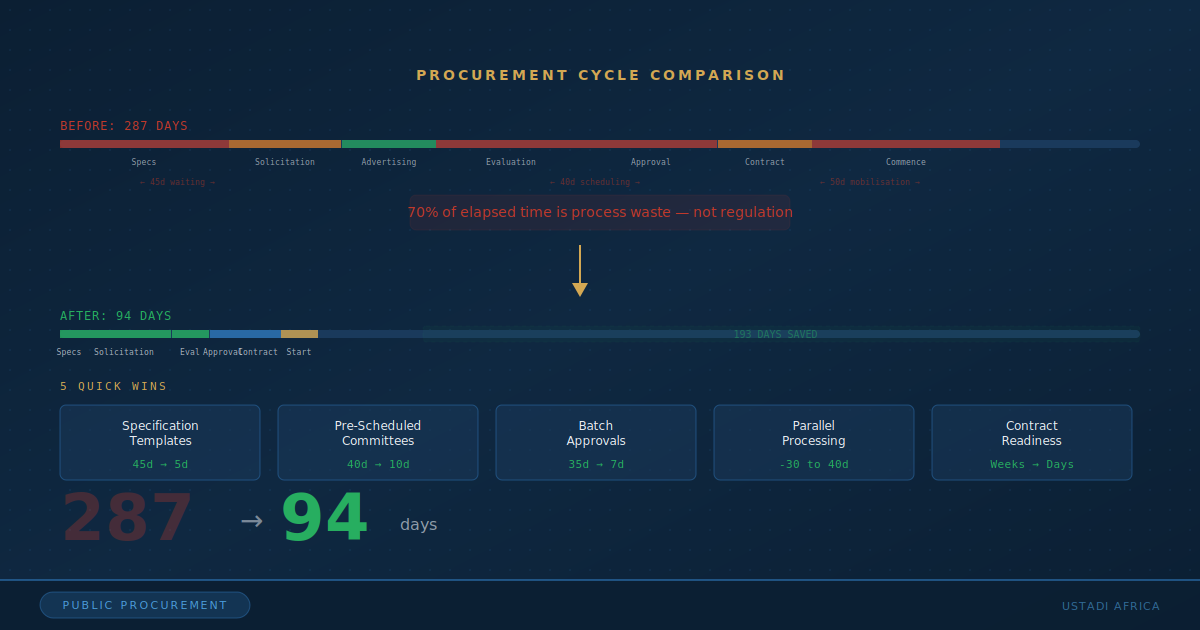
The instinctive response is to blame regulation. PPADA is too complex. The thresholds are too low. The evaluation requirements are too demanding. But in our experience mapping procurement cycles across county governments, regulation accounts for less than 30% of the elapsed time. The remaining 70% is wasted — in handoffs, waiting times, scheduling failures, and unnecessary approval loops.
Where the Time Actually Goes
A typical 287-day procurement cycle breaks down approximately as follows: Requisition to specification completion: 45 days. Most of this is waiting — the requisitioning department submits a vague request, procurement returns it for clarification, and it sits on someone's desk for two weeks. Specification to solicitation: 30 days. Preparing tender documents, obtaining approvals to advertise, and posting the advertisement. Advertising period: 21-30 days. This is regulatory — PPADA minimum timelines. Solicitation to evaluation: 40 days. Waiting for the evaluation committee to be convened, scheduled, and complete their work. Evaluation to approval: 35 days. The evaluation report moves through the approval chain — procurement committee, accounting officer, and tender committee. Approval to contract: 25 days. Notification, standstill period, contract drafting, legal review, and signing. Contract to commencement: 50 days. Mobilisation, advance payment processing, and site handover.
The regulatory minimum for all these stages combined is approximately 75-90 days. The remaining 197 days are process waste.
The 5 Quick Wins
1. Specification Templates
Create pre-approved specification templates for the 20 most commonly procured items and services. When a department submits a requisition, they select the appropriate template and fills in quantities. Specification time drops from 45 days to 5.
2. Pre-Scheduled Evaluation Committees
Appoint evaluation committees at the time of tender launch, not at bid receipt. Schedule the evaluation meeting date before the tender closes. Committee members block their calendars in advance. Evaluation time drops from 40 days to 10.
3. Batch Approval Sessions
Instead of routing each procurement file individually through the approval chain, schedule weekly batch approval sessions. All files ready for approval are reviewed in a single sitting. Approval time drops from 35 days to 7.
4. Parallel Processing
Many procurement steps are done sequentially when they could be parallel. Legal can review contract terms while the evaluation is being completed. Budget codes can be confirmed while specifications are being finalised. Parallel processing can eliminate 30-40 days from the total cycle.
5. Contract Readiness Checklist
Prepare all contract execution requirements — bank guarantees, insurance certificates, site access — before the award decision. When the contract is awarded, execution happens within days, not weeks.
Results
In one county government engagement, these five changes reduced the average procurement cycle from 287 days to 94 days. All within existing PPADA requirements. No regulatory change needed. The delays were never in the regulations — they were in the handoffs.
Want to map your procurement cycle bottlenecks? Contact for a procurement cycle diagnostic.