·
· Nairobi, Kenya

Supply Chain Advisory — East Africa

We build your supply chain
and train your team to run it.

For NGOs, governments, DFIs and private companies across East Africa.

Ustadi — Swahili for mastery — built in East Africa, for East Africa.

Your Organisation. Your Problem. Our Fix.

If your procurement is stalled, your audit is at risk, or your supply chain is leaking money — here is exactly what we do about it.

Pick the challenge closest to what you are dealing with right now. Each one links to a specific service with a named deliverable and a clear outcome.

Supplier Sourcing & Vetting

Stop buying blind — find suppliers who can actually deliver in your market

See the fix

ESG & Compliance Auditing

Know every gap in your procurement files before the auditor finds it

See the fix

Procurement Setup & Unblocking

Clear the backlog, build the system, and get your spending moving again

See the fix

Distribution & Last-Mile Delivery

Get your stock out of the warehouse and into the hands of the people who need it

See the fix

Market & Feasibility Research

Make your investment and programme decisions on real market data, not desk assumptions

See the fix

Programme Evaluation & Baselines

Give your donors the evidence they require — produced to the standard they expect

See the fix

Procurement & e-GP Training

Build a procurement team that runs the process right and keeps the organisation audit-clean

See the fix

Donor Compliance Training

Train your programme staff to stay audit-ready under the specific donor framework governing their work

See the fix

What You Walk Away With

We don't leave you with a slide deck. We leave you with the thing that fixes the problem.

Files that pass the audit

Documentation rebuilt against the exact checklist your donor's auditor uses — not generic best practice.

Money that actually moves

Every blocked procurement named, sequenced, and cleared — so the budget is spent before the deadline, not after the warning letter.

Stock that reaches the shelf

A distribution route and a tracking system your own team can run after we've gone — built for your geography, not a textbook.

Every engagement ends with a named deliverable and a team that can keep it running. Ask us for references from organisations we've done this for.

About Ustadi Africa

We work here. Not from a head office in another time zone.

We're a supply chain advisory firm based in Nairobi, working across East Africa. When something in your procurement or supply chain is bleeding money, stalling a programme, or threatening your funding — that's what we come in to fix.

"Ustadi" is Swahili for mastery. We chose it on purpose: knowing the theory isn't enough here — you have to know how things actually work on the ground. So we diagnose before we prescribe, and we build your team up rather than keep you dependent on us.

Read more about how we work →
We diagnose before we prescribe.

We find out what's actually wrong before we tell you how to fix it. No off-the-shelf answers.

African frameworks, not European adaptations.

Built for how procurement actually works here — the regulations, the gaps, the suppliers you can really reach.

We build capability, not dependency.

If your team can't run it without us six months later, we didn't do our job.

Three things we do. All of them essential.

Building supply chains. Researching decisions. Training your team.

01
Building Your Supply Chain

Your supply chain is losing money, blocking programme delivery, or failing donor audits. We come in, find the exact break — supplier failure, procurement blockage, last-mile collapse — and fix it with a system your team can run after we leave.

Who this is for: NGOs, county governments, corporates whose procurement or logistics is underperforming

02
Research for Decisions

You are about to enter a new market, launch a programme, or commit budget to a supplier you haven't verified. We give you field-based intelligence — real market data, real supplier assessments, real demand figures — before you commit.

Who this is for: DFIs, donors, programme leads, and private companies expanding in East Africa

03
Training Your Team

Your staff are managing procurement, handling donor money, and operating e-GP systems — without ever being trained on the actual rules. We train them on what the law requires, what the donor expects, and what the auditor will look for. NITA-accredited.

Who this is for: Procurement officers, finance staff, grant managers, and county government teams

Tell us what's broken.

One conversation. We'll tell you honestly whether we can fix it, how long it takes, and what it costs. No obligation, no sales pitch.

About Ustadi Africa

The frameworks failed you.
Not the other way round.

If you run procurement or supply chains in East Africa, you already know the problem. The tools on offer were built for stable, data-rich environments — then applied unchanged to a context where funding collapses overnight, data lives in WhatsApp groups, and a single audit finding can freeze a grant.

See What We Fix Describe Your Situation

Why We Exist

Built for the environment you actually operate in.

"Ustadi" is Swahili for mastery — chosen deliberately. Meaningful advisory in a complex domain requires deep contextual understanding, not just technical competence.

Across Kenya's public and development sectors, the same failures repeat: procurement decisions without market intelligence; training built on international curricula that ignores Kenyan regulatory reality; supply chain assessments designed for conditions that don't exist here.

The Challenge

USAID dismantled. The Global Fund tightening audits on every Kenyan recipient. Counties absorbing barely half their development budgets. The operating environment keeps shifting.

Our Commitment

We diagnose before we prescribe. We build for East Africa's actual structures. We measure success by what your organisation can do after we leave.

Our Grounding

Seven years of advisory practice across East Africa. NITA-accredited training. Active research into procurement in Kenyan state corporations.

Our Credentials

A specialist practice built on seven years of East African advisory work.

7+
Years Active

Supply chain advisory practice across Kenya and East Africa

4
Sectors Served

NGOs, government, development finance institutions, and private sector

NITA
Accredited Training

All procurement and e-GP training programmes are nationally accredited

Research Grounding

Active doctoral research into procurement implementation in Kenyan state corporations — findings applied directly to every client engagement.

Ground-Level Experience

Prior operational experience within Kenya's public health supply chain system, giving us first-hand understanding of how procurement actually fails in practice.

Ustadi Africa is the trading name of Umahiri Advisory, registered as a business name under the laws of Kenya.

How We Work

Three phases. No phase is skipped.

01
Diagnose

We map the operating environment — supply chain configuration, institutional constraints, risk exposure, and capability gaps — before forming any hypothesis about what needs to change.

Deliverable: Situation analysis and validated risk register

02
Fix

Strategies, remediation plans, or training programmes designed to your specific context. Not templated.

Deliverable: Intervention plan with named, dated deliverables

03
Embed

Knowledge, systems, and processes are transferred into your organisation. Performance should continue after our engagement concludes.

Deliverable: Trained teams, embedded systems, performance baseline

Tell us what needs fixing.

Describe the operational challenge. We'll respond within one business day with an honest assessment of whether and how we can help.

Our Services

We build supply chains, train your team, and research the decisions that matter.

Eight specialist services across procurement, logistics, research, and training — built for how East Africa actually works.

PILLAR 1

Building Your Supply Chain

We build the foundation and move it efficiently.

Supplier Sourcing & Vetting

Stop buying blind — find suppliers who can actually deliver in your market

Most organisations in East Africa are still buying from one or two suppliers they inherited — no performance data, no backup, no competitive pressure. When that source fails — a funding cut, a quality failure, a currency move — the supply chain stops and programmes stall. We map the real supplier landscape for your commodity, assess every candidate against what actually matters in your operating environment, and hand you a vetted shortlist you can buy from with confidence.

What your procurement team gets:
  • Supplier IdentificationA mapped landscape of suppliers who can actually deliver your commodities at your scale — including local sources most procurement officers overlook due to lack of market information.
  • Supplier Pre-QualificationEvery candidate scored against a clear, documented framework — business registration, financial stability, delivery capacity, and quality systems — so your procurement decisions are defensible.
  • Supplier Due DiligenceIndependent verification of what suppliers claim about their credentials, capacity, and track record — so you are not caught out after you have signed the order.
  • Supplier Database DevelopmentA living, structured supplier database your procurement team can draw from for future purchases — eliminating the cost and delay of starting every sourcing exercise from scratch.
  • Supplier Performance AssessmentFor your existing suppliers, a scored assessment of delivery reliability, quality compliance, and value for money — giving you the evidence to retain, develop, or replace.
  • Local Supplier DevelopmentWhere no qualified local supplier exists for a critical commodity, we identify and help develop one — reducing import dependency and shortening your supply chain risk exposure.

ESG & Compliance Auditing

Know every gap in your procurement files before the auditor finds it

The Global Fund, USAID, FCDO, EU, and your corporate buyers are all looking for the same thing: documented evidence that procurement was competitive, traceable, and compliant with the specific rules governing your funding. A single gap — a missing competitive bid, an undocumented waiver, a supplier without the required certification — can freeze a grant disbursement or end a supplier relationship. We audit against the exact standard your reviewer uses, identify every gap, and give you a time-bound remediation plan before the review.

What your compliance and finance team gets:
  • Procurement Compliance AuditsA file-by-file review of your procurement records against your donor's exact checklist — delivered before the auditor arrives, with every gap named and graded by risk level.
  • ESG AssessmentsAn assessment of your procurement operations against Environmental, Social, and Governance standards — increasingly required by development finance institutions and international buyers.
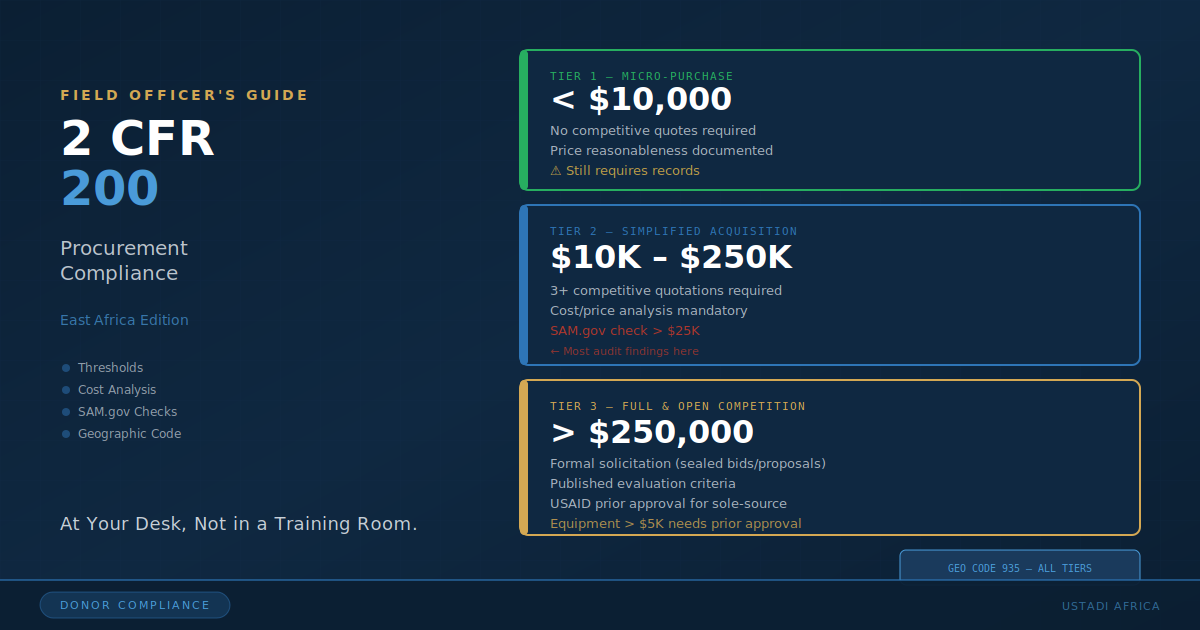
  • Donor Compliance ReviewsSpecific review against USAID (2 CFR 200), Global Fund, FCDO, or EU PRAG requirements — whichever framework governs your current funding, applied with the rigour the donor uses.
  • Supplier Compliance AuditsAn audit of your key suppliers' own compliance documentation and practices — because a supplier's non-compliance can produce findings against your organisation in a donor review.
  • Procurement Risk AssessmentsIdentification of the procurement decisions, documentation gaps, and approval patterns most likely to generate findings in your next external review — before that review happens.
  • Corrective Action PlanningEvery gap gets a specific, dated, responsible-party remediation action — a plan your team can execute in the window before the follow-up review, not after.

Procurement Setup & Unblocking

Clear the backlog, build the system, and get your spending moving again

Procurement stalls for specific, fixable reasons: no approved policy, no procurement plan, one signatory who is never available, a specification that keeps going back for revision, or a system nobody was trained to use. Kenya's counties absorbed only 57% of their development budgets in 2024/25 — not because the money was not there, but because these bottlenecks were never diagnosed and cleared. We find the exact block and remove it — then build the system that stops it recurring.

What your organisation gets:
  • Procurement System SetupAn end-to-end procurement process configured for your organisation — covering every step from purchase request to goods receipt, with clear roles, approval thresholds, and working templates.
  • Procurement Policy DevelopmentA PPADA-compliant, donor-aligned procurement policy your team can actually follow — not a downloaded template that looks correct but fails under scrutiny at the first audit.
  • Procurement PlanningAn annual procurement plan built from your budget and programme calendar — so purchases are anticipated and timed correctly, not rushed at financial year-end under pressure.
  • Tender Management SupportEnd-to-end management of your tender process — from specification writing and advertisement through evaluation and award — producing a defensible result that holds up to challenge.
  • e-GP Implementation SupportConfiguration and operationalisation of Kenya's e-GP system for your entity — covering plan upload, approval workflow, and reporting so the system works as intended, not as a source of complaints.
  • Procurement Process ImprovementFor organisations where the process exists but underperforms — a diagnostic of the specific failure points, followed by targeted redesign of only what needs to change.

Distribution & Last-Mile Delivery

Get your stock out of the warehouse and into the hands of the people who need it

The product is in the warehouse. It is not reaching the clinic, the outlet, or the community. This gap — between central stock and the point of need — is where supply chains lose the most value and where programmes fail to demonstrate impact. Hard-to-reach geographies, no route plan, stock sitting at the wrong facility, and zero visibility into what is actually being delivered are the norm. We visit the delivery points, map the real problem, and redesign only what needs to change.

What your operations and logistics team gets:
  • Distribution Network DesignThe right distribution model for your geography and product type — from a single central warehouse to a multi-tier network reaching remote health facilities or last-mile communities.
  • Route OptimizationCost-effective delivery routes based on your actual volumes, geography, vehicle capacity, and road conditions — reducing cost per delivery and cutting the time between warehouse and end user.
  • Warehouse-to-End-User MappingA traced journey from central storage to the patient, customer, or community member — identifying every point where stock is lost, delayed, diverted, or fails to reach its destination.
  • Inventory Redistribution PlanningA system to identify and move excess stock from overloaded points to facilities running short — preventing both expiry waste and stockouts at the same time.
  • Delivery Performance ReviewsMeasurement of your current distribution performance — on-time delivery rate, order completeness, cost per delivery point, and loss rate — giving you the baseline for improvement.
  • Last-Mile Delivery AssessmentsA structured assessment of the final leg of your supply chain — the most expensive, least visible, and most likely to fail — with specific, actionable findings your logistics team can act on.
PILLAR 2

Research for Decision Making

We provide the evidence you need to decide.

Market & Feasibility Research

Make your investment and programme decisions on real market data, not desk assumptions

Organisations enter markets, launch programmes, and commit procurement budgets based on assumptions that have never been tested in the field. Suppliers who look credible on paper cannot deliver at scale. Demand estimates turn out to be wrong. The route to market costs three times what was projected. We produce market intelligence gathered from primary research in the actual geography — with real suppliers, real buyers, and real logistics providers — before the money is committed.

What your leadership and programme team gets:
  • Market AssessmentsA structured analysis of the market you are entering, expanding in, or sourcing from — covering size, competitive dynamics, buyer behaviour, price benchmarks, and real barriers to entry.
  • Feasibility StudiesAn evidence-based assessment of whether your planned programme, product launch, or investment is viable in this specific market — including the conditions that would make it fail.
  • Supplier Market StudiesA primary-research picture of who supplies your commodity in your market, at what quality, at what price, and with what delivery reliability — based on field interviews, not supplier brochures.
  • Route-to-Market AnalysisThe real cost and operational complexity of getting your product or service from source to end user — channels, intermediaries, logistics costs, regulatory requirements, and risk points mapped.
  • Demand AssessmentsA segmented estimate of how much of your product or service the market genuinely needs and can absorb — by geography, buyer type, and purchasing power — based on field data, not desk assumptions.
  • Investment Opportunity AssessmentsFor development finance institutions and private investors, an independent assessment of a specific supply chain investment — covering risk, return potential, and conditions required for success.

Programme Evaluation & Baselines

Give your donors the evidence they require — produced to the standard they expect

Donors require documented evidence that their funding produced results. Before a programme begins, they want a baseline. At the end, they want an evaluation that demonstrates measurable change. Most implementing organisations lack the internal research capacity to produce studies that satisfy major donors without revision requests. We produce them to the methodological standard that institutional funders, academic reviewers, and audit bodies accept — on time and to specification.

What your programme and M&E team gets:
  • Baseline StudiesA rigorous measurement of conditions before your programme begins — establishing the evidence base against which end-of-programme results will be compared, to the methodological standard your donor specifies.
  • Mid-Term EvaluationsAn independent, structured assessment of whether your programme is on track at the halfway point — what is working, what is not, and what changes to make before it is too late to course-correct.
  • End-Term EvaluationsA comprehensive assessment of whether the programme achieved its stated objectives, at what cost, and what the evidence says about the durability of results beyond the funding period.
  • Impact AssessmentsAn assessment of the actual change your programme produced in the operations, livelihoods, or systems it targeted — going beyond outputs and activity counts to documented outcomes.
  • Performance ReviewsA structured review of how a programme, team, supply chain function, or supplier is performing against agreed targets — with specific gap analysis and root-cause findings your team can act on.
  • Monitoring & Evaluation Framework DevelopmentDesign of the M&E system for your programme before implementation begins — covering indicators, data collection methods, reporting frequency, and the field tool your team will actually use.
PILLAR 3

Training & Capacity Building

We build the capability that keeps it running.

Procurement & e-GP Training

Build a procurement team that runs the process right and keeps the organisation audit-clean

Procurement fails when the people responsible for it were never trained on the actual rules and systems they operate. County teams go live on e-GP without knowing how to upload a procurement plan. Officers write tender documents that collapse at evaluation. Contracts are managed informally because no one was ever taught the formal process. The result is audit findings, delayed spending, and frustrated donors. Our NITA-accredited training is built around how procurement actually works in Kenya — not theoretical frameworks from another context.

Training programmes for procurement officers, finance staff, and management in your organisation:
  • Public Procurement TrainingPractical training on Kenya's Public Procurement and Asset Disposal Act (PPADA) — what it requires at each stage, how to comply in practice, and exactly what generates an audit finding.
  • e-GP System TrainingStep-by-step training on Kenya's electronic government procurement system — covering registration, procurement plan upload, approval workflows, and report generation for finance and audit teams.
  • Strategic Sourcing TrainingHow to analyse spend, segment suppliers, and make sourcing decisions that reduce cost and supply risk — rather than simply processing purchase orders and hoping suppliers perform.
  • Tender Evaluation TrainingHow to design, run, and document a tender process that produces a defensible award — one that holds up to scrutiny from an auditor, a disappointed bidder, or a donor compliance review.
  • Contract Management TrainingHow to manage a contract from award to close-out in the Kenyan context — covering performance monitoring, variation management, payment certification, and dispute resolution.
  • Procurement Planning TrainingHow to build an annual procurement plan that is realistic, properly linked to the budget, and actually results in purchases arriving when programmes need them — not two months late.

Donor Compliance Training

Train your programme staff to stay audit-ready under the specific donor framework governing their work

Each major donor — USAID, Global Fund, FCDO, EU — has its own procurement rules, documentation requirements, and audit standards. A team that managed USAID-funded procurement well can generate findings when the same programme transitions to FCDO, because the rules are materially different. Staff rotate, institutional memory disappears, and new programme cycles bring new frameworks nobody has been trained on. We train your people on the specific rules governing their current work — not a generic overview.

Training programmes for programme staff, finance officers, and grant managers in your organisation:
  • USAID Compliance TrainingTraining on 2 CFR 200 procurement requirements as applied to your programme — covering competitive sourcing thresholds, documentation standards, waiver conditions, and the behaviours that trigger OIG findings.
  • Global Fund Compliance TrainingTraining on Global Fund procurement rules and principal recipient obligations — including how to prepare for an OIG review and what documentation the review team will request at the outset.
  • FCDO Compliance TrainingTraining on FCDO procurement requirements and due diligence standards — specifically the differences from USAID rules that catch experienced NGO procurement teams off-guard when programmes change funders.
  • EU Procurement Rules TrainingTraining on EU PRAG procurement procedures — one of the most demanding donor frameworks to comply with, covering thresholds, documentation requirements, and evaluation methodology in detail.
  • Grant Management TrainingHow to manage a grant from award letter to close-out — covering financial reporting requirements, procurement documentation obligations, budget flexibility rules, and audit preparation.
  • Audit Readiness TrainingHow to prepare your programme team and filing systems for a donor audit — what auditors look for first, how to organise documentation by procurement line, and how to respond to findings professionally.

Tell us what you need built.

Describe the challenge. We scope it and come back with a clear plan and fixed fee.

Who We Serve — Industries & Sectors

Different sector. Different rules. Same commitment to fixing what is broken.

We don't apply one-size-fits-all frameworks. We build solutions specific to your sector.

View What We Fix →

Sectors We Serve

🏛
Public Sector & Government
PPADA compliance · e-GP · county procurement · budget absorption
🌍
NGOs & Development
Humanitarian logistics · donor compliance · last-mile delivery
🏢
Private Sector
Supplier risk · import logistics · regional expansion
🏦
DFIs & Investors
Disbursement readiness · ESG due diligence · project appraisal
Based in Nairobi · Serving Africa   Enquire →

Your budget isn't moving and the Controller of Budget has noticed.

Kenya's counties absorbed only 57% of development budgets in 2024/25. Procurement plans don't coordinate, specifications stall at review, approvals wait on one officer. We unblock procurement pipelines, recover absorption before the fiscal year closes, and build audit-ready processes that survive the Auditor-General.

Tell us about your sector.

Each sector brings specific requirements. Describe your situation and we'll explain how we've approached similar challenges.

Engagement Examples

Real problems we were called in to fix — and what we did about them.

These are representative of the work we do. For client-specific results and references, just ask — we'll connect you with people who can speak to it directly.

Field Notes from East African
Supply Chains

Grounded analysis on procurement reform, supply chain disruptions, and the forces shaping how organisations operate across Africa.

18 Articles
11 Topics
7 Countries
Follow on LinkedIn

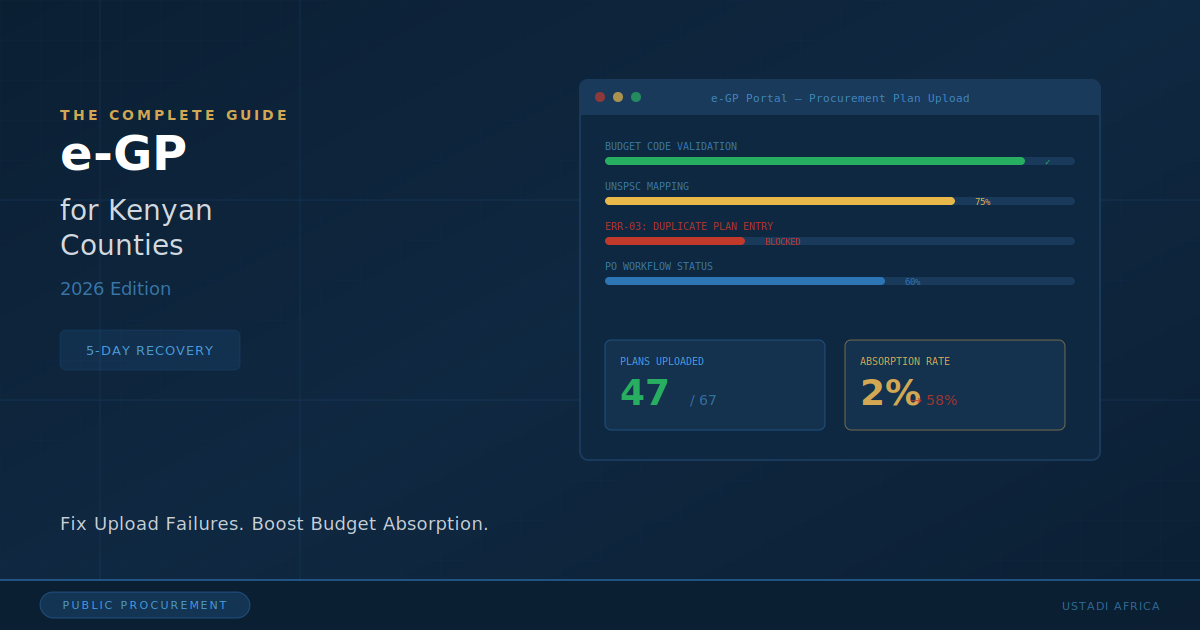
The Complete Guide to e-GP for Kenyan Counties (2026) — Fix Upload Failures & Boost Budget Absorption

Step-by-step guide to Kenya's e-GP system for county procurement teams. Fix procurement plan upload failures, resolve UNSPSC mapping errors, and accelerate budget absorption. Based on field experience across multiple counties.
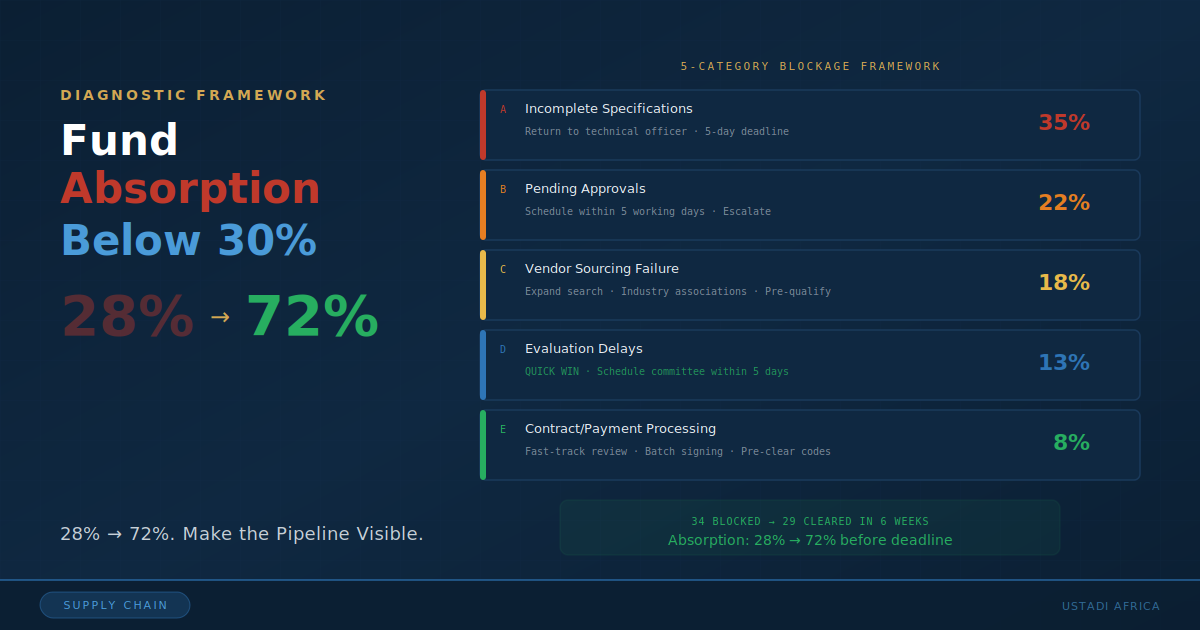
The Budget Absorption Crisis
In Q1 of FY 2025/26, twenty Kenyan counties recorded zero development spending. Not low spending — zero. The mandatory e-GP system designed to improve procurement transparency has become the single point of failure for county development programmes. Budget absorption rates have fallen to 2% in some counties, with procurement plans stuck in draft status, purchase orders unprocessable, and an entire fiscal year's development allocation at risk of lapsing.
This is not a technology problem. It is a capability gap between generic classroom training and the specific operational demands of a complex digital procurement system. County procurement teams attend two-hour orientations, receive certificates, and return to their desks unable to complete a single upload.
How the e-GP System Works
Kenya's e-GP system is mandatory for all public procurement under the Public Procurement and Asset Disposal Act (PPADA 2015). Every purchase order, every tender, every contract must flow through this system. The process follows a strict sequence: budget allocation in IFMIS, procurement plan creation and approval in e-GP, solicitation and evaluation management, contract award, purchase order generation, and payment processing.
Each step depends on the previous one. If procurement plans cannot be uploaded, nothing else can happen. No plans means no tenders. No tenders means no contracts. No contracts means no spending. The entire development pipeline freezes.
The 5 Most Common e-GP Errors
Based on our direct experience recovering e-GP systems across multiple county governments, five errors account for approximately 80% of all failures:
1. Budget Code Mismatch (ERR-01)
The single most common error, causing approximately 30% of all blocked plans. The e-GP system rejects the procurement plan because budget codes do not match IFMIS allocations. The most frequent cause is trailing spaces copied from Excel spreadsheets. Resolution: verify every vote head character by character against the IFMIS budget printout. Paste through Notepad first to strip hidden formatting.
2. UNSPSC Code Mapping Failure (ERR-02)
Items in the procurement plan cannot be matched to United Nations Standard Products and Services Codes. The system requires 8-digit UNSPSC codes for every line item. Generic descriptions like "Office Supplies" are rejected. Resolution: map each item to the most specific 8-digit code. "Laptop computers" (43211503) not "Computer equipment" (43210000). Maintain a county-wide UNSPSC mapping register.
3. Duplicate Plan Entry (ERR-03)
The system detects a previous draft or rejected version and blocks the new upload. Users create multiple attempts, each blocking the next. Resolution: navigate to Plan Management, delete all stuck drafts for this department and financial year, then wait 5 minutes before reuploading.
4. Supplier Registration Blocks (ERR-04)
Vendors cannot participate in tenders because their e-GP registration is pending, rejected, or incomplete. Common blockers include expired tax compliance certificates from KRA, missing business permits, and incomplete AGPO documentation. Resolution: check vendor portal status, guide suppliers through document requirements, and allow 3-5 working days for verification.
5. PO Approval Workflow Stalls (ERR-05)
Purchase orders created but stuck in the approval chain. The most common cause is an approver who has not logged into e-GP since being assigned, or whose role permissions are misconfigured. Resolution: check which approver the PO is waiting on, verify their account is active, and escalate through the Accounting Officer if pending more than 5 working days.
The 5-Day Recovery Protocol
When a county has 20 or more blocked procurement plans and budget absorption is below 10%, the following intensive recovery protocol has been proven to restore system functionality:
Day 1 — Diagnostic: Export all draft, rejected, and pending plans. Categorise every blocked plan by error code. Rank by budget impact.
Day 2 — Budget Code Resolution: Cross-reference every e-GP budget code against IFMIS. Fix mismatches. Clear duplicate drafts. Target: all budget code and duplicate errors resolved.
Day 3 — UNSPSC Mapping: Complete code mapping for all remaining line items. Fix specifications and threshold calculations. Upload corrected plans in priority order. Target: 60% of blocked plans uploaded.
Day 4 — Supplier and PO Processing: Resolve supplier registration blocks. Configure approval chains. Test PO creation. Target: remaining plans uploaded, first POs processing.
Day 5 — Verification: Verify every plan shows "Approved" status. Process at least one PO per department. Conduct competency assessment. Brief the Accounting Officer.
Preventing Recurrence
Recovery is meaningless if the same errors recur next quarter. Three protocols prevent recurrence: (1) Monthly plan health checks — review all plan statuses on the first working day of each month. (2) New staff onboarding — every new procurement team member completes a supervised e-GP upload within their first week. (3) UNSPSC master register — every new item procured is mapped once and shared across departments.
When You Need Specialist Support
This guide covers the most common errors. If your county has more than 20 blocked plans, budget absorption is below 10%, and the fiscal year is closing within 14 weeks, consider engaging specialist support. On-site teams who work screen-by-screen inside your live e-GP system with your actual procurement plans can typically restore functionality within 5-10 working days.
Download the free e-GP Recovery Playbook at ustadiafrica.com — or describe your situation at ustadiafrica.com/contact for a diagnostic assessment.

Share: Share on LinkedIn Share on X

Describe Your Breakdown.

Follow Ustadi Africa on LinkedIn for analysis, or tell us about your supply chain challenge.

Get in Touch

Tell Us What’s Not Working.

Describe the problem. We tell you if we can help, how long it takes, and what it costs. One business day response.

Email Us WhatsApp
Book a 20-minute diagnostic call
Reach Us Directly

Contact Information.

Email
Project briefs, service enquiries, general questions. We respond within one business day.
Phone & WhatsApp
Available Monday to Friday, 8am to 6pm East Africa Time.
Base Location
Nairobi, Kenya
Serving clients across East Africa. In-person engagements in Nairobi by arrangement.
LinkedIn
Connect and follow for supply chain perspectives on African supply chains.
What to Include in Your Message

The more context you can provide, the more useful our initial response will be. Helpful to include: your organisation type and sector, the specific challenge you are facing, and whether you have a defined brief or are still scoping the engagement.

Send a Brief

Describe Your Situation.

Step 1 of 2 — You & the Problem
You can submit after the next step, or skip ahead and send now.

Step 2 will ask about your organisation type, sector, and timeline.

Quick Answers

Frequently Asked.

What happens after I submit this form? +

Our team reviews every enquiry personally. You will receive a response within one business day with an initial assessment of whether and how we can help. If the engagement requires scoping, we will suggest a brief diagnostic call.

Is there a minimum engagement size? +

We work across a range of engagement sizes. Our smallest engagements are targeted training sessions; our largest span multi-country research studies. If you are not sure, describe the challenge and we will tell you what scope makes sense.

Can I book a call instead of filling out the form? +

Yes. You can book a 20-minute diagnostic call directly, or reach us on WhatsApp at .

Privacy Policy

Last updated: April 2026

1. Introduction

Ustadi Africa (the trading name of Umahiri Advisory, registered in Kenya) is committed to protecting the privacy of visitors to ustadiafrica.com. This policy explains what data we collect, how we use it, and your rights.

2. Data We Collect

We collect minimal data. Our site does not require user registration, and we do not sell, trade, or otherwise transfer personal information to third parties.

Analytics data: If you consent, we collect anonymised usage data through Google Analytics 4 (measurement ID G-3BXBTJGHDT). This includes pages visited, approximate geographic region, device type, and referral source. IP addresses are anonymised before processing.

Contact form submissions: If you submit an enquiry through our contact form, we collect the information you provide (name, email, organisation, and message). This data is processed through Formspree and used solely to respond to your enquiry.

3. Use of Cookies

Our site uses a cookie consent mechanism. On your first visit, you are asked whether you accept analytics cookies. If you decline, no analytics cookies are set and no tracking data is collected.

4. Google Analytics

When analytics consent is granted, Google Analytics collects anonymised browsing data. We have enabled IP anonymisation, and we do not use Google Advertising features. Google’s privacy policy applies to data processed by their services. You can opt out at any time by updating your cookie preferences via the banner or by clearing your browser’s local storage.

5. Your Rights

You have the right to decline analytics tracking at any time through the cookie consent mechanism on this site. If you have submitted a contact form enquiry and wish to request deletion of your data, you may contact us at the address below.

Since we collect only anonymised analytics data and voluntary contact form submissions, we hold very little personal information. We retain contact form submissions only as long as necessary to respond to and follow up on your enquiry.

6. Contact

For any privacy-related questions or data requests, please contact us at: info@ustadiafrica.com

Data Controller: Umahiri Advisory (trading as Ustadi Africa), Nairobi, Kenya.

Engagement Model

Transparent pricing. Fixed fees. No billing surprises.

We believe in transparent pricing. Every engagement is scoped individually, but these frameworks give you a clear sense of investment levels before we talk.

How Pricing Works

Every engagement is priced based on scope, complexity, and duration. We provide a fixed-fee quote after an initial scoping conversation — no hourly billing surprises. Typical investment levels are shared during the scoping call.

What Happens After You Contact Us

Typical Engagement Lengths

What’s Always Included

Site Map

All Pages on Ustadi Africa

A complete index of every page on this site. Also available as sitemap.xml for search engines.

Case Studies
Free Resources
Field Notes
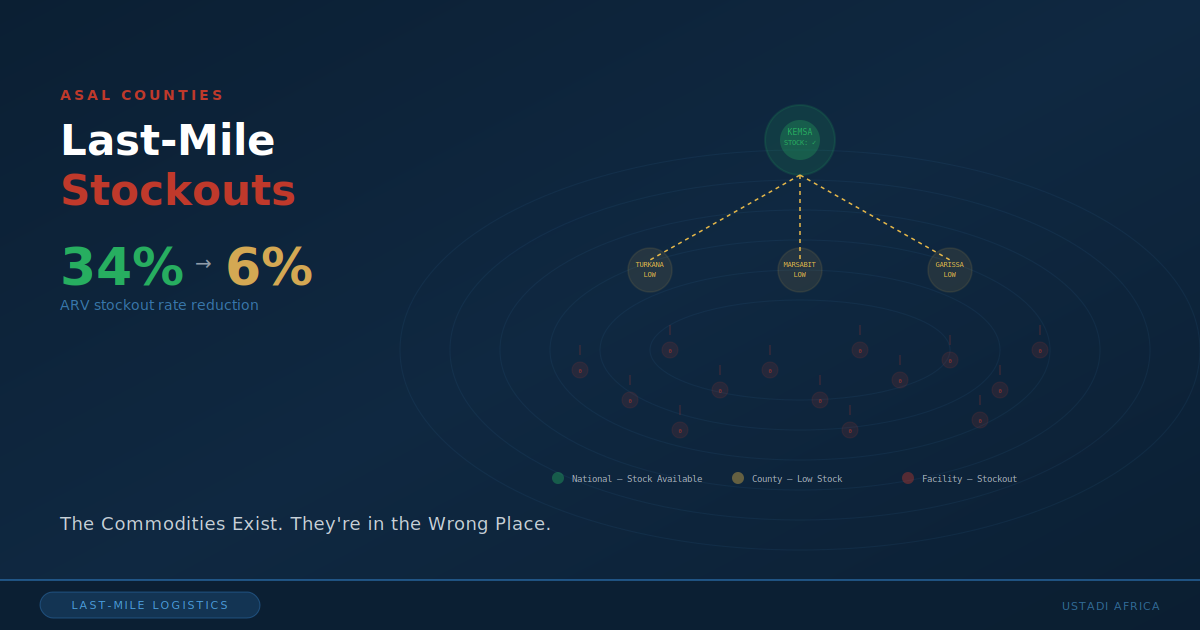
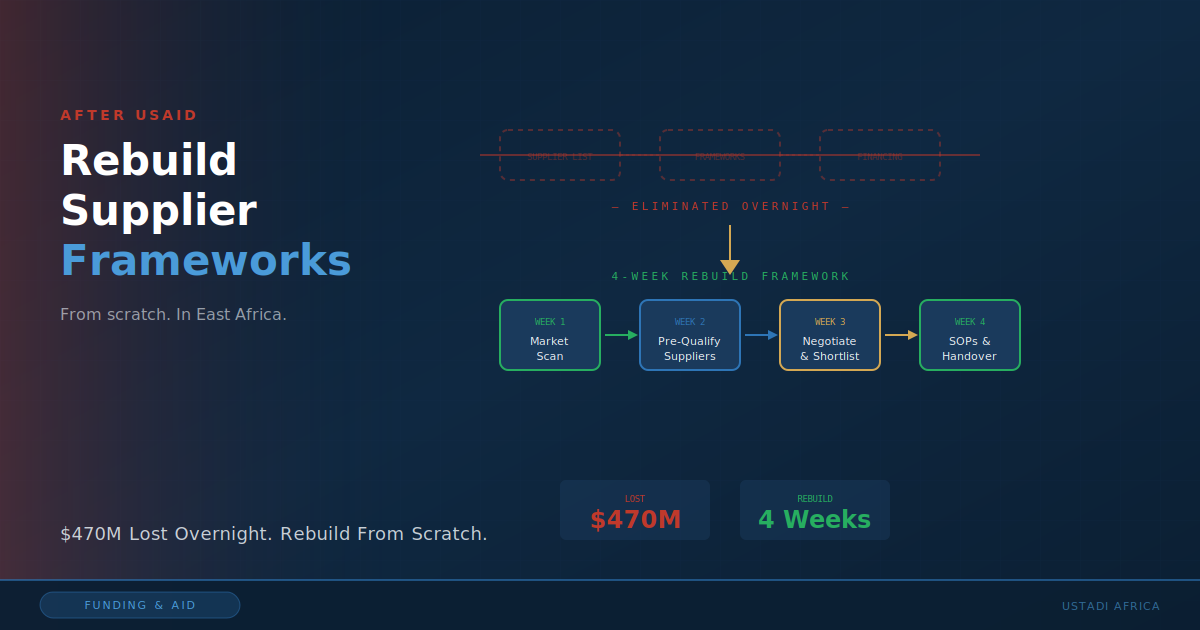
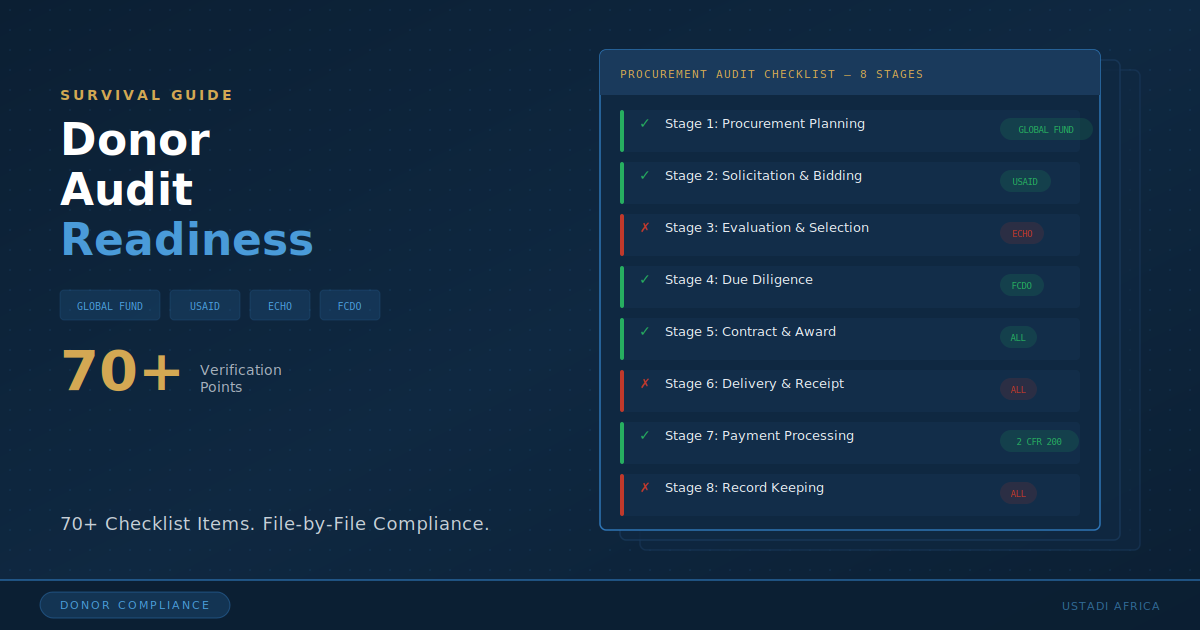
Fund Absorption Below 30%? A Diagnostic Framework for Unb… Kenya PMI Below 50: What Sustained Business Contraction M… 2 CFR 200 Procurement Compliance: The Field Officer's Gui… Why Procurement Cycle Optimisation Fails in Kenya — And H… Supply Chain Risk Assessment for East Africa: A Step-by-S… Red Sea Shipping Disruptions 2026: Impact on East African… Solving Last-Mile Stockouts in Kenya's ASAL Counties: A D… After USAID: How to Rebuild Supplier Frameworks from Scra… Donor Audit Survival Guide: Global Fund, USAID 2 CFR 200,… China Just Opened Its Market to Kenya. But Can We Walk Th… The Pump Price Went Up. Then Everything Else Followed. The Complete Guide to e-GP for Kenyan Counties (2026) — F… The Bill From the Strait of Hormuz Just Arrived at the Pu… We Grew More Avocados Than Ever. And We Can't Get Them Ou… So If Fuel Disappears, What's Plan B? Fuel Is Still 178 Bob. But Try Finding It. Fuel Is Still KSh 178. But For How Long? We're Queuing for Fuel. Turns Out, the Problem Was Not th…