Why Absorption Stalls
Low fund absorption is one of the most persistent challenges in development finance in Africa. Funds are disbursed on schedule. Implementing partners have approved work plans and budgets. Programme activities are designed. But the procurement pipeline — the mechanism that converts budget into goods, services, and works — blocks at every stage.
The root cause is almost never a single bottleneck. In our experience across DFI-funded programmes in East Africa, low absorption is caused by 20-40 individual procurement transactions, each blocked for a different reason. The implementing partner cannot see the pipeline clearly enough to know where to intervene. The funder sees only the absorption rate declining. Both parties feel frustrated, but neither can identify the specific actions that would change the trajectory.
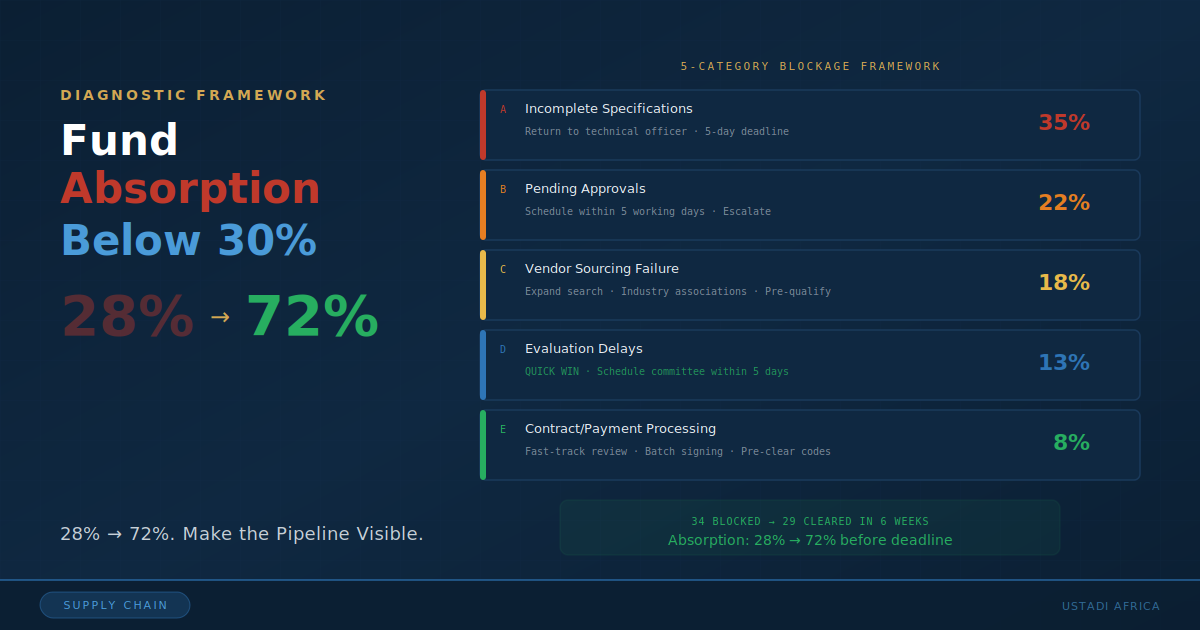
The 5-Category Blockage Framework
Every blocked procurement falls into one of five categories. Categorising the blockage determines the resolution pathway, the responsible person, and the expected clearance time.
Category A: Incomplete Specifications (30-40% of blockages)
The procurement cannot proceed because technical specifications, terms of reference, or scope of work are incomplete. This is consistently the largest category because programme teams design activities but do not write procurement specifications. The resolution: return specifications to the requesting technical officer with a template and a 5-working-day deadline. Offer a specification writing support session — two hours in the same room, specification completed before leaving.
Category B: Pending Approvals (20-25%)
Specifications complete, file ready, but sitting on someone's desk. The procurement committee has not convened. The accounting officer is travelling. The donor has not provided a no-objection. Resolution: identify the specific person and step, schedule approvals within 5 working days, and escalate through the programme director with a deadline.
Category C: Vendor Sourcing Failure (15-20%)
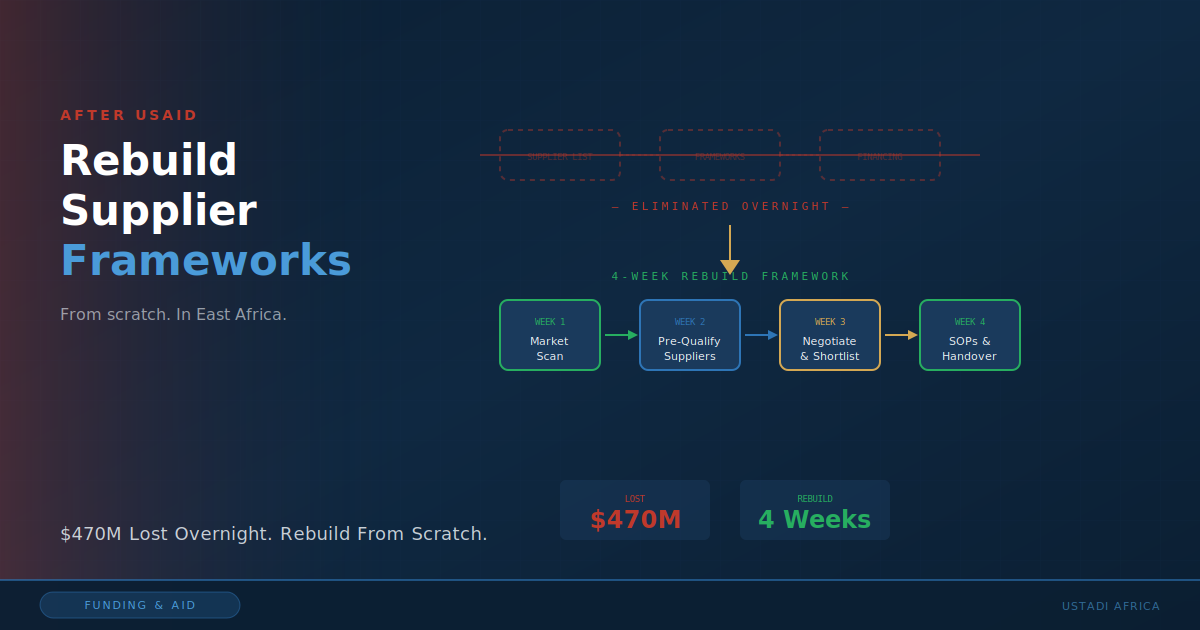
Qualified vendors cannot be found, or insufficient bids have been received. Post-USAID restructuring, this category has grown significantly as framework agreements were eliminated. Resolution: expand the supplier search beyond existing databases, contact industry associations, and consider pre-qualification in parallel with the tender process.
Category D: Evaluation Delays (10-15%)
Bids received, but the evaluation committee has not convened. This is a quick win — all the procurement work is done, the delay is purely scheduling. Resolution: Schedule the evaluation committee within 5 working days. Non-negotiable.
Category E: Contract/Payment Processing (5-10%)
Procurement awarded, but contract execution or payment processing is stalled. Legal review delays, signatory unavailability, and budget code errors. Resolution: fast-track contract review, batch signing sessions, and pre-clear budget codes before contract signature.
The Clearance Protocol
After categorising all blockages, prioritise by value and clearance speed. Clear high-value, quick-fix items first (Category B and D above KES 2M). This maximises the absorption rate improvement per unit of effort. Track progress weekly with a simple dashboard showing: total blocked, cleared this week, cumulative cleared, and current absorption rate. Share this with the funder every week — it demonstrates systematic progress and buys you time.
Results
Using this framework in a DFI-funded programme in Kenya, we diagnosed 34 blocked procurements, cleared 29 within 6 weeks, and raised absorption from 28% to 72% before the reporting deadline. The formal low-absorption review was avoided. The key was not working harder — it was making the pipeline visible and clearing blockages in priority order.
Get the free Absorption Acceleration Diagnostic → — or contact us for an embedded engagement.