What Was Lost
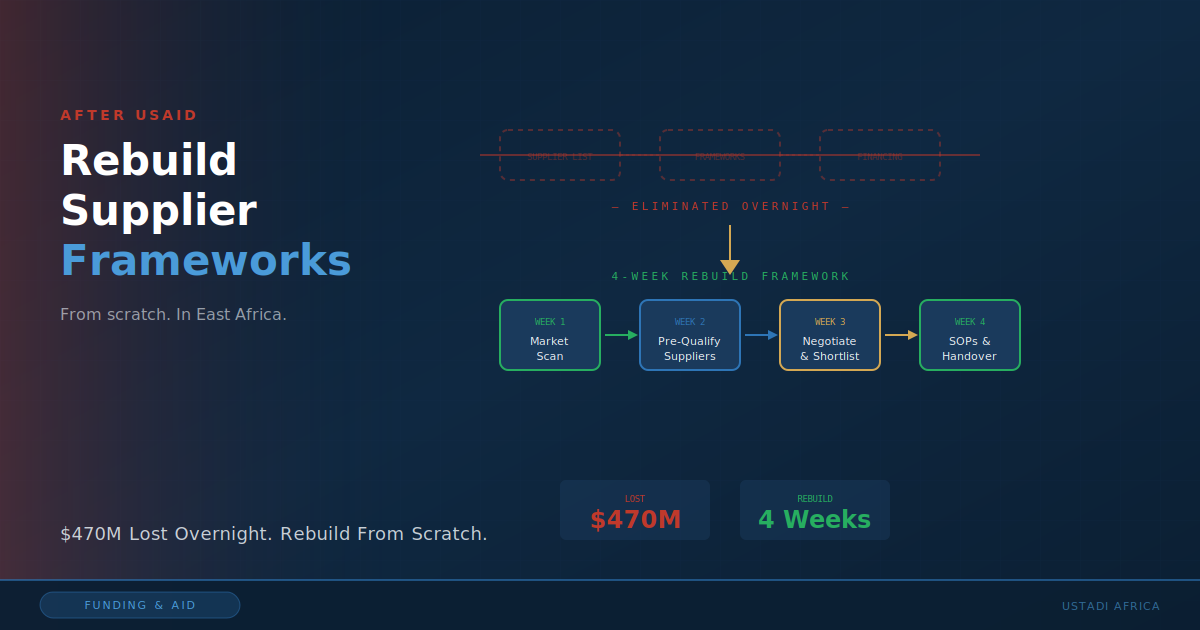
The USAID restructuring of early 2025 eliminated approximately USD 470 million annually from Kenya's development ecosystem. But the funding loss was only part of the damage. What many organisations lost was infrastructure — the procurement infrastructure they had relied upon for years without building their own.
Pre-approved supplier lists built over a decade of vetting. Framework agreements with negotiated pricing and quality guarantees. Commodity financing mechanisms that allowed procurement to proceed before funds cleared. Logistics networks with established routes and warehousing. Quality assurance systems with batch tracking and temperature monitoring. All gone — not gradually, but overnight.
Why Standard Procurement Approaches Will Not Work
The standard procurement response — issue a tender, wait for responses, evaluate, award — assumes a functioning supplier market that you can access through competitive processes. For many commodity categories in East Africa, that assumption does not hold after the USAID withdrawal. The suppliers who were pre-qualified under USAID frameworks may no longer be operational. The ones who remain may not meet the quality standards your other donors require. And the procurement timelines your new funding cycles allow may be too short for traditional competitive processes.
The 4-Week Supplier Rebuilding Framework
Week 1: Market Scan
Identify the commodity categories where you need suppliers. For each category, map the local supplier landscape: manufacturers, importers, and distributors. Use industry associations, chambers of commerce, trade directories, and field contacts. The goal is a long list of 8-15 potential suppliers per category.
Week 2: Pre-Qualification Assessment
Assess each potential supplier against a scoring framework covering four dimensions: regulatory compliance (Pharmacy and Poisons Board, NCA, or sector-specific registration), quality management systems (ISO, GMP, or equivalent), financial stability (audited accounts, bank references), and delivery capacity (warehousing, logistics, track record). Desk research identifies candidates; field visits confirm capability.
Week 3: Shortlist and Negotiate
From the pre-qualification assessment, shortlist 3-5 qualified suppliers per category. Negotiate framework terms: pricing, delivery timelines, quality guarantees, payment terms. Design these for shorter funding cycles — 6-12 months rather than multi-year agreements.
Week 4: SOPs and Handover
Develop new procurement standard operating procedures designed for the post-USAID reality. These must accommodate shorter planning horizons, smaller order quantities, local sourcing preferences, and the compliance requirements of your remaining donors. Train your procurement team on the new SOPs and hand over the vetted supplier register with all documentation.
Maintaining the Framework
A supplier framework is not a one-time exercise. Track supplier performance on every delivery: quality, timeliness, completeness, documentation. Review the framework quarterly. Replace underperforming suppliers before a crisis forces emergency procurement. Expand the register proactively — identify and assess new suppliers even when you do not have immediate needs.
Facing a supplier gap after USAID restructuring? Describe your situation at ustadiafrica.com/contact — we have rebuilt supplier frameworks for health, logistics, and programme operations across East Africa.